

Chemical formulas and atom counting are critical aspects of modern chemistry. Knowing how to count the number of atoms in a formula is essential for understanding chemical reactions and developing new compounds. In this post, we will explore the concept of atom counting and provide answers to a worksheet on the number of atoms in a formula.
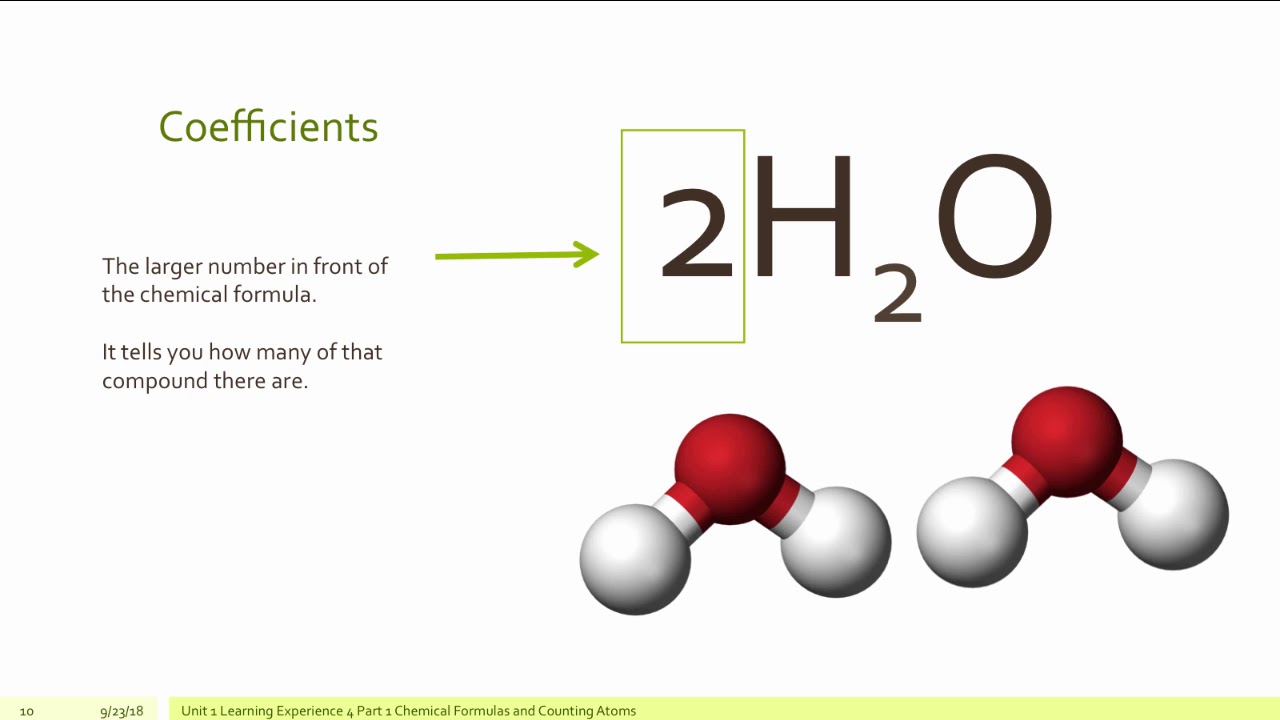
To begin, it is essential to understand what a chemical formula is. A chemical formula is a representation of a chemical compound using symbols for its constituent elements. For example, the chemical formula for water is H2O, where H represents hydrogen and O represents oxygen. A chemical formula provides information about the types of atoms present in a compound and the number of each type of atom.
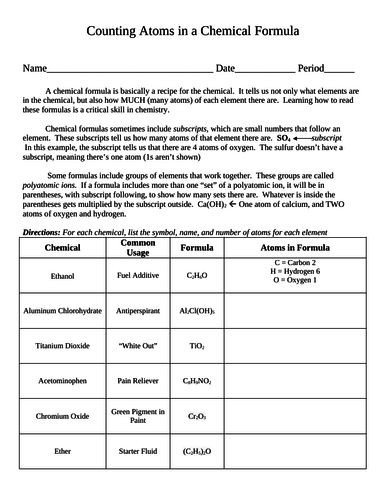
Counting the number of atoms in a formula is a straightforward process. To count the number of atoms of a specific element in a formula, you can multiply the number of atoms by the subscript of that element. For example, in the chemical formula H2O, there are two hydrogen atoms and one oxygen atom. The number of hydrogen atoms is multiplied by two because the subscript 2 indicates two hydrogen atoms. Therefore, the formula has two hydrogen atoms and one oxygen atom.
Another essential concept to consider when counting atoms is the difference between molecular and empirical formulas. A molecular formula shows the exact number of atoms of each element in a molecule, while an empirical formula shows the simplest whole-number ratio of atoms in a molecule. For example, the empirical formula for hydrogen peroxide is HO, while the molecular formula is H2O2.
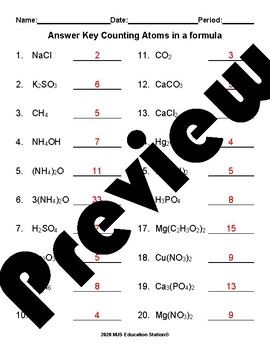
Now, let’s take a look at the worksheet on the number of atoms in a formula. The worksheet provides several chemical formulas and asks the reader to count the number of atoms of each element in the formula. For example, the first formula is NaCl, which represents sodium chloride, or table salt. The formula has one sodium atom and one chlorine atom, so the answer is Na: 1, Cl: 1.
The worksheet also includes more complex formulas, such as Ca3(PO4)2, which represents calcium phosphate, a mineral present in bones and teeth. To count the number of atoms in Ca3(PO4)2, we need to start by multiplying the subscript 3 to the Ca and the subscript 2 to the PO4. This results in three calcium atoms, two phosphorus atoms, and eight oxygen atoms. Therefore, the answer is Ca: 3, P: 2, O: 8.
In conclusion, counting the number of atoms in a formula is a fundamental skill in chemistry. It provides critical information about the nature of chemical compounds and their reactivity. By following simple rules, such as multiplying the number of atoms by the subscript, anyone can count atoms in a formula. We hope this post has been informative and helped shed light on this important topic.
If you are searching about Number Of Atoms In A Formula Worksheet Answers – ariannanews you’ve visit to the right web. We have 5 Pictures about Number Of Atoms In A Formula Worksheet Answers – ariannanews like 26 Number Of Atoms In A Formula Worksheet Answers – Worksheet Information, Number Of Atoms In A Formula Worksheet Answers – ariannanews and also Chemical Formulas & Atom Counting – YouTube. Here you go:
Number Of Atoms In A Formula Worksheet Answers – Ariannanews
ariannanews.blogspot.com
Chemical Formulas & Atom Counting – YouTube
www.youtube.com
atom chemical formulas counting
Counting The Type And Number Of Atoms In A Chemical Formula Worksheet
www.tes.com
atoms counting
Number Of Atoms In A Formula Worksheet Answers – Nidecmege

nidecmege.blogspot.com
fliphtml5 atoms answers
26 Number Of Atoms In A Formula Worksheet Answers – Worksheet Information
nuviab6ae4.blogspot.com
atoms
Atoms counting. Chemical formulas & atom counting. Counting the type and number of atoms in a chemical formula worksheet

