
In mathematics, finding the domain and range of a function is crucial to understanding its behavior and characteristics, as it allows for a better comprehension of how the function behaves under various circumstances. In this post, we will explore how to find the domain and range of a function, and we will provide some practice problems to help cement these concepts.
Domain and Range: What Are They?
The domain of a function refers to the set of all possible input values for that function, while the range refers to the set of all possible output values for that function. In other words, the domain is the set of x-values that can be plugged into the function, while the range is the set of y-values that the function outputs.
For example, consider the function f(x) = x^2. The domain of this function is all real numbers, because any real number can be squared. The range, however, is only the set of non-negative real numbers, because any negative value squared yields a positive value.
Finding the Domain and Range
One way to find the domain and range of a function is to look at its graph. The x-values that appear in the graph represent the domain, while the y-values that appear in the graph represent the range. For example, consider the graph below:
From this graph, we can see that the domain of the function is all real numbers, while the range is from -2 to 2 (inclusive).
Another way to find the domain and range is to algebraically manipulate the function. For example, consider the function f(x) = sqrt(x-1). To find the domain, we must ensure that the expression under the square root sign is non-negative. Therefore, we must have x ≥ 1. Thus, the domain of this function is [1, ∞). To find the range, we can examine the behavior of the function as x goes to infinity and negative infinity. As x goes to negative infinity, we have f(x) ≈ 0. As x goes to infinity, we have f(x) ≈ ∞. Therefore, the range of this function is [0, ∞).
Practice Problems
Now that we have discussed the theory behind domain and range, let’s put it into practice. Consider the following graph:

Problem 1
What is the domain of this function?
Answer: (0, ∞)
Problem 2
What is the range of this function?
Answer: [0, ∞)
Problem 3
What is the x-intercept of this function?
Answer: (10, 0)
Problem 4
What is the y-intercept of this function?
Answer: (0, 9)
By understanding domain and range, we are better equipped to analyze and manipulate functions in mathematics. With enough practice, these concepts will become second nature, allowing us to analyze complex functions with ease.
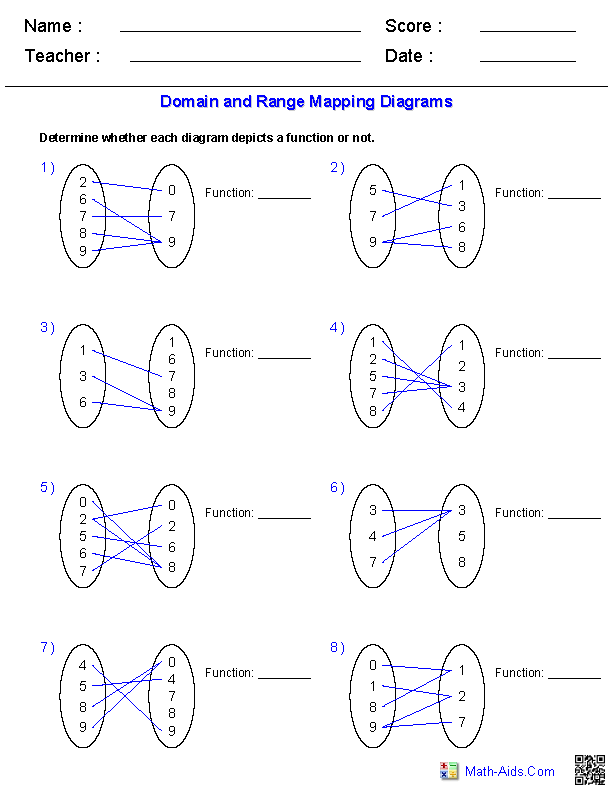
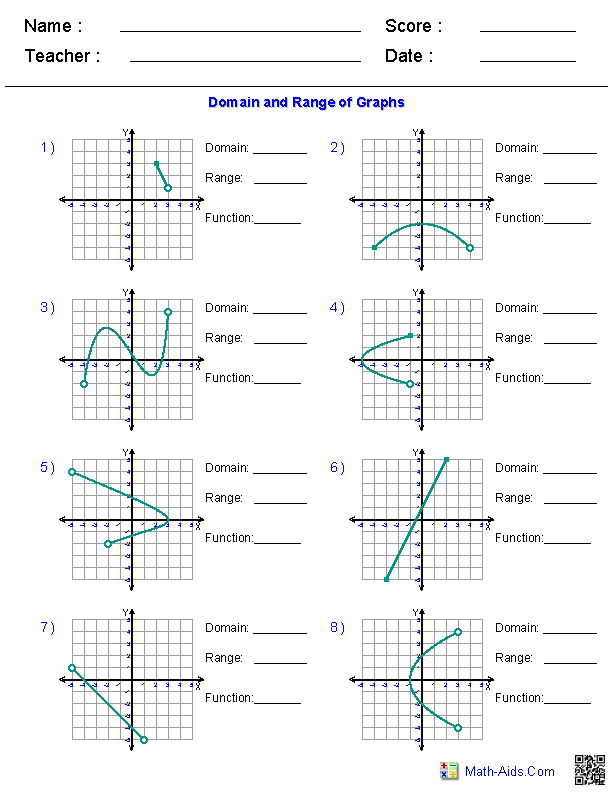
If you are looking for Domain And Range Of Quadratics Worksheet Answers Breadandhearth you’ve came to the right web. We have 5 Images about Domain And Range Of Quadratics Worksheet Answers Breadandhearth like Domain and Range Practice Worksheet 34 Domain and Range Graphs, Function Worksheets and also Engaging students: Finding the domain and range of a function Mean. Here it is:
Domain And Range Of Quadratics Worksheet Answers Breadandhearth
byveera.blogspot.com
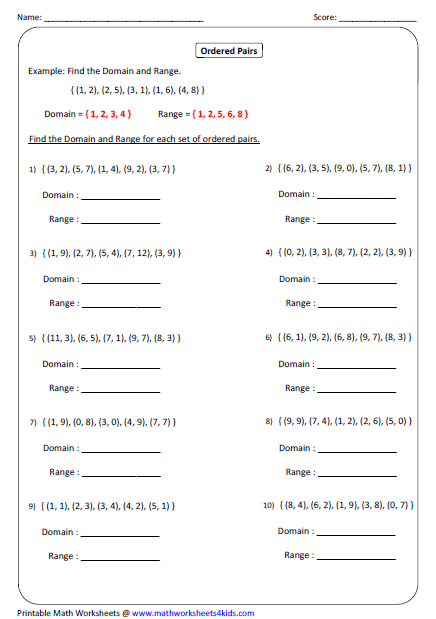
Function Worksheets
www.mathworksheets4kids.com
domain range function mathworksheets4kids worksheets worksheet math key answer answers graphing algebra functions grade ordered pairs equation table kids school
Engaging Students: Finding The Domain And Range Of A Function Mean
byveera.blogspot.com
algebra math grade relations graphing aids mathematics notation linear inequalities kidsworksheetfun calculus multiplication fractions domäne seventh chessmuseum
Domain And Range Practice Worksheet 34 Domain And Range Graphs
www.pinterest.com
precalculus
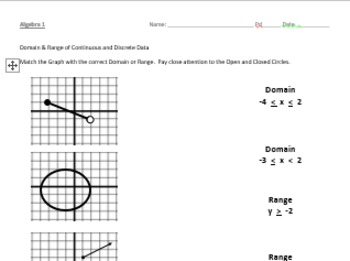
Domain And Range Practice Worksheet By It's About Math Connections
www.teacherspayteachers.com
range domain worksheet practice worksheets subject math
Domain range function mathworksheets4kids worksheets worksheet math key answer answers graphing algebra functions grade ordered pairs equation table kids school. Function worksheets. Domain and range practice worksheet 34 domain and range graphs

