
Numbers are a fundamental part of chemistry, and one of the most important concepts is the number of atoms in a formula. Understanding the number of atoms in a formula is essential to be able to make accurate measurements in a laboratory and to understand the behavior of compounds in various chemical reactions. In this post, we will explore the concept of the number of atoms in a formula, as well as how to convert between particles and moles using Avogadro’s number.
To begin, let us look at the formula for water, H2O. This formula tells us that water is made up of two hydrogen atoms and one oxygen atom. Each element has a specific number of atoms that it contributes to a compound, and these numbers can be determined using the periodic table. For example, hydrogen has an atomic number of 1, which means that each hydrogen atom has one proton in its nucleus. Oxygen, on the other hand, has an atomic number of 8 and thus has eight protons in its nucleus.
When we want to determine the number of atoms in a formula, we must first determine the atomic weight of each element in the compound. Once we know the atomic weight, we can then calculate the number of atoms in each molecule using Avogadro’s number, which is 6.022 x 10²³. For example, in the formula for water, we would calculate the number of atoms as follows:
– Hydrogen: 2 atoms x (1 mole/6.022 x 10²³ atoms) = 3.32 x 10^-24 moles of hydrogen atoms
– Oxygen: 1 atom x (1 mole/6.022 x 10²³ atoms) = 1.66 x 10^-24 moles of oxygen atoms
From these calculations, we can see that there are approximately 3.32 x 10^-24 moles of hydrogen atoms and 1.66 x 10^-24 moles of oxygen atoms in one molecule of water.
Now, let us consider how to convert between particles and moles using Avogadro’s number. Avogadro’s number is defined as the number of atoms, molecules, or other particles in one mole of substance. One mole of a substance is defined as the amount of that substance that contains the same number of particles as there are atoms in 12 grams of carbon-12. This means that Avogadro’s number is the same for all substances, regardless of their atomic weight or chemical properties.
To convert between particles and moles, we can use the following formula:
– particles = moles x Avogadro’s number
For example, if we want to know how many particles are in 2 moles of water, we can calculate:
– particles = 2 moles x 6.022 x 10²³ particles/mole = 1.2044 x 10²⁴ particles of water
Similarly, if we want to know how many moles are in 5.5 x 10²¹ particles of carbon dioxide (CO2), we can use the same formula:
– moles = particles/Avogadro’s number
– moles = 5.5 x 10²¹ particles/(6.022 x 10²³ particles/mole) = 0.091 moles of CO2
In conclusion, understanding the number of atoms in a formula and how to convert between particles and moles using Avogadro’s number is essential to the study of chemistry. By using the periodic table and Avogadro’s number, we can determine the number of atoms in any compound and convert between different units of measurement to make accurate measurements in the laboratory.
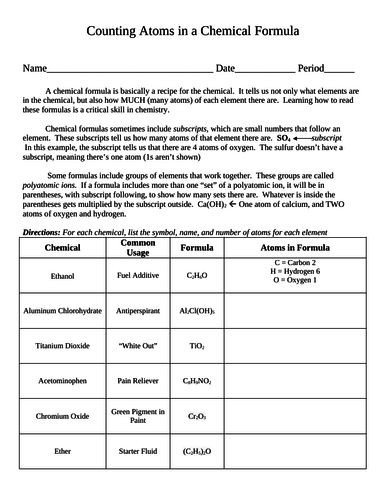
If you are looking for Counting the Type and Number of Atoms in a Chemical Formula Worksheet you’ve came to the right place. We have 5 Pics about Counting the Type and Number of Atoms in a Chemical Formula Worksheet like Counting Atoms in a Formula – ChemSimplified, Chem 02: Converting Between Particles and Moles Using Avogadro’s Number and also number of atoms in a formula | Teaching Resources. Here it is:
Counting The Type And Number Of Atoms In A Chemical Formula Worksheet
www.tes.com
atoms counting
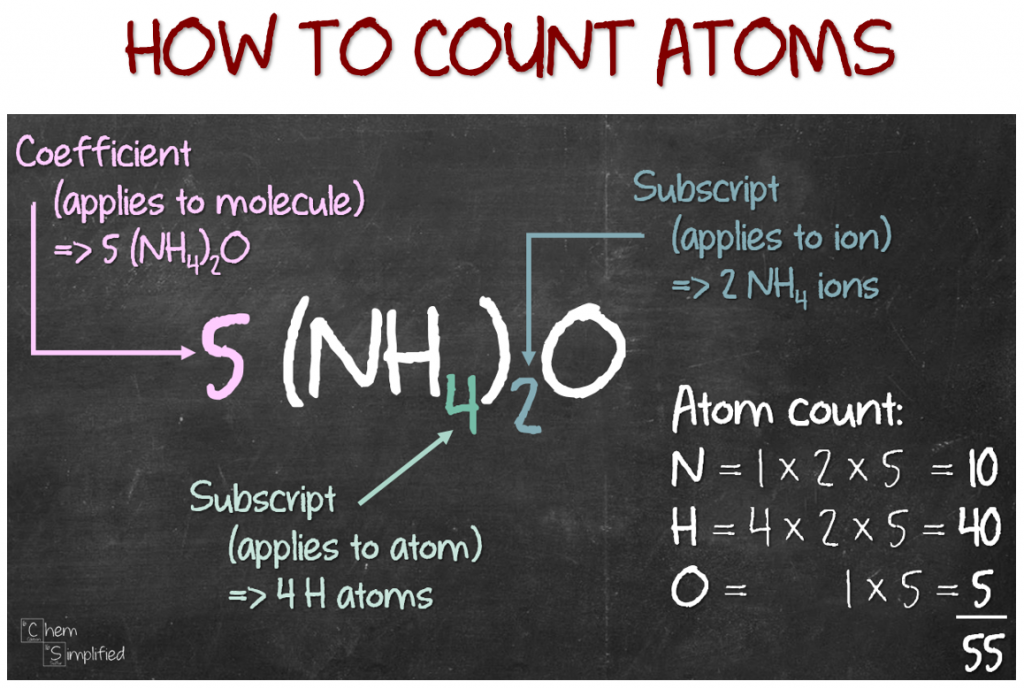
Counting Atoms In A Formula – ChemSimplified
chemsimplified.com
atoms formula counting count if
How To Find Number Of Atoms From Moles

goodttorials.blogspot.com
number atoms mole avogadro calculator moles convert molecules find cloudshareinfo
Chem 02: Converting Between Particles And Moles Using Avogadro’s Number

scienceandjoe.com
moles conversion number converting particles between formula avogadro units molecules atoms using use factors formulas chem avogadros calculate science
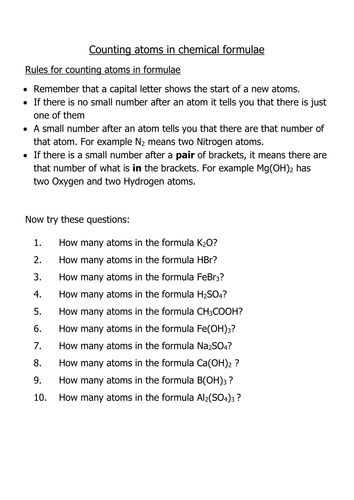
Number Of Atoms In A Formula | Teaching Resources
www.tes.com
atoms formula number tes different does why look
Chem 02: converting between particles and moles using avogadro’s number. Atoms formula counting count if. Counting the type and number of atoms in a chemical formula worksheet

